
Why AI Is Smart and Dumb at the Same Time
The top AI models right now, Opus 5.5, Astra, Sol, Argon, DeepSeek, are still surprisingly dumb, even on high-thinking variants.
People assume models are geniuses because they write working code and generate clean prose. In reality, code is a structured domain with strict grammar, deterministic syntax trees, and massive volumes of public training data. When an LLM writes software, compilers, linters, and test suites act as an external verification loop that catches mistakes and enforces correctness.
Step outside that structured environment into normal everyday tasks, even asking a model to write an authentic blog post, and the output drops straight to the level of a toddler.
Most white-collar work looks easy for LLMs for the same reason. Content, SaaS workflows, spreadsheets, and IT infrastructure are largely text, logic, and structured data moving through predefined pipes.
Now take a top vision-language model, hook it up to 3D robotic controls with multiple camera feeds, and ask it to move a toy car across a desk. It fails completely. Camera feeds get flattened into 2D pixel grids with zero intuitive grasp of physical depth, continuous force, or friction.
The ecosystem illusion
Modern models are posting higher benchmark scores, yet a lot of that perceived leap in intelligence is an illusion of tooling.
The progress runs in a cycle. Models improve because they receive an endless stream of curated feedback from millions of developers and users correcting bad outputs every day. The model assists the user, and the user constantly trains the model.
Hardware expanded, and the execution layer around the weights matured so rapidly that if you took base models from two years ago and dropped them into today's software stack, they would perform dramatically better than they did at launch.
When Claude or ChatGPT first arrived, there was no Codex or Claude Code. There was no scaffolding to pull out what the model could actually do.
Now systems run with massive context windows, prompt caching, thought signatures that preserve reasoning state across API calls, and protocol standards like MCP and agent skills. The engineering around the model is doing the heavy lifting.
I like AI. It can handle heavy workloads and will replace certain roles, but it is simultaneously brilliant and profoundly dumb.
What "not real intelligence" gets wrong
Even with those flaws, dismissing LLMs as "not real intelligence" is lazy.
What is real intelligence? Nobody has a complete theory of how the human brain produces it.
Biological brains run on continuous spike timing, neurochemical modulation, and local synaptic plasticity. Artificial neural networks run on static weights, matrix multiplication, and backpropagation. Mechanically, they are worlds apart.
The mistake is assuming that biological wetware is the only valid path to intelligence. What happens inside human biology is one path. What transformers do through statistical pattern extraction across language might be another.
Calling it "not real intelligence" moves the goalposts around a concept nobody has defined. Current models are obviously limited pattern-matching engines, but humans are also giant pattern matchers operating across physical reality.
We have not built general intelligence. An architectural breakthrough, specialized hardware, or a fundamentally new training algorithm might still be required. But writing the technology off entirely because its mechanism is non-biological misses the point.
White-collar bias and undocumented intelligence
Our view of machine intelligence is distorted because our definition of human intelligence was already skewed.
Society treats lawyers, doctors, and people in cognitive professions as intelligent, while viewing uneducated physical workers as simple.
Take a traditional hunting tribe. They might not know arithmetic, formal physics, or modern world affairs. Put someone from that tribe in front of a running animal with a bow and arrow, and watch what happens.
Calculating the launch angle, arrow velocity, wind drift, target acceleration, and release timing to hit a moving animal in a canopy requires massive real-time computational precision. Throwing a ball, navigating dense terrain, or reading physical wear on a machine are all forms of learned intelligence running continuously in real time.
The difference is that modern culture documents screen work. We record text, publish papers, and create institutional credentials, which creates the illusion that moving symbols on a screen is the peak of human capability. We only recognize intelligence when someone sits at a desk in formal attire looking at a monitor.
AI looks superhuman because we trained it to mimic that exact documentation bias. It can draft a legal summary or refactor a backend service, yet it cannot coordinate the physical common sense needed to navigate a room.
The two real blockers: passive context and the input tax
The real technical limits on autonomous AI come down to two bottlenecks: context capacity and the interaction model.
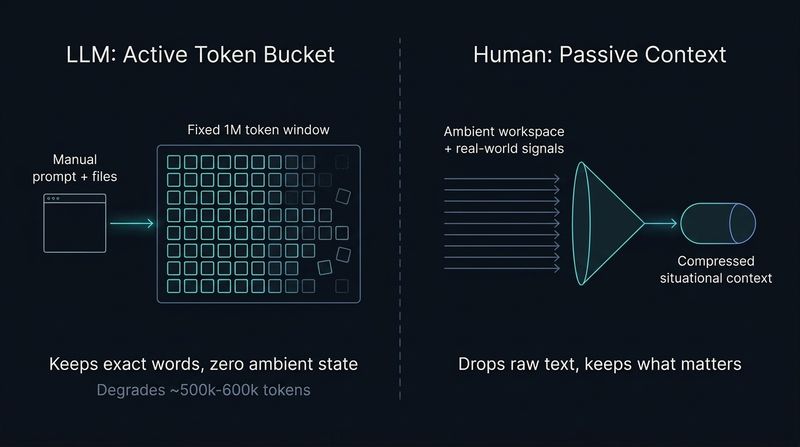
A one-million-token context window sounds massive on a spec sheet, even if attention retrieval starts degrading past 500,000 tokens. Compared to human cognition, it remains tiny.
Humans operate with an unlimited, passively activated context stream. An LLM stores text by brute force: feed it a 100,000-token document and ask for a specific detail, like the color of an obscure object on page 40, and it retrieves it instantly where a human would forget.
Yet a human moving through a regular workday passively absorbs millions of multimodal sensory inputs, discarding the raw text and preserving the compressed essence, the atmosphere, unspoken team dynamics, and baseline reality.
That brings up the second issue: the input tax.
Current AI is entirely reactive. Every bit of context has to be actively pushed through a prompt, an uploaded file, or a dictation feed. You cannot simply have a model passively monitor your screen and audio all day, because the token window fills up within hours.
Offloading background data into vector databases or long-term memory stores turns the model into a search engine querying stale logs, which is completely different from maintaining live situational awareness. The model remains dependent on humans doing the cognitive labor of curating its inputs.
Well, it's complicated
Consider a 100-page contract.
Reading 100 pages takes hours for a person, and nobody can query a human brain like an exact index. An LLM digests the document in seconds and answers specific lookup questions instantly.
Ask the model to evaluate the contract's risks, and the limit appears immediately. The model flags fifty potential issues based on generic training definitions. It cannot distinguish between an unacceptable liability clause and a standard term your company accepts every week.
Everything depends on context, and real-world context resists clean binary rules. Most operational questions boil down to one phrase:
Well, it's complicated.
Now compare that to a human intern who joined four weeks ago.
The intern might miss minor typos in the contract that the AI caught. But the intern walks into your office and says: "Section 4 demands a thirty-day delivery turnaround. We cannot sign that because our engineering team is down two people this month and already behind schedule."
The intern did not extract that insight from the contract. They absorbed it passively by sitting in team meetings, watching colleague workloads, and observing the state of the office.
Even if you attempted to digitize every detail, company policies, team hierarchies, individual capabilities, and cost averages into searchable markdown behind a RAG pipeline, the model will still approve a proposal that an employee would immediately reject.
The employee rejects it because tomorrow is a local public transit strike, half the team will be absent, and the office cannot take on new commitments. The AI approved it because that reality was never recorded in a file.
Even with an unlimited context window, you will always miss something, because the model does not live in the real world.