No-BS Blockchain Quick Facts
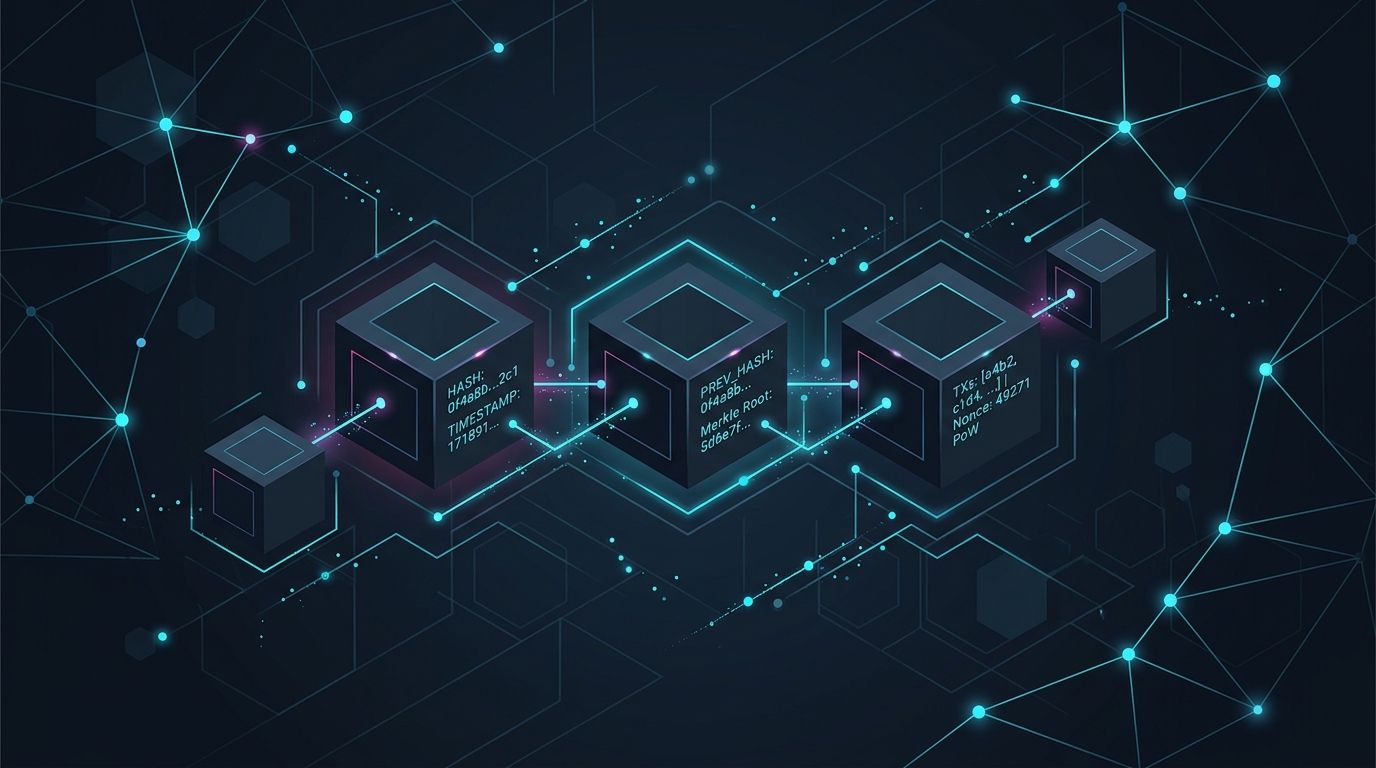
Strip away the pitch decks, Twitter threads, and Web3 buzzwords. Underneath the speculative circus, a blockchain is just a slow, append-only distributed ledger governed by network rules and cryptography.
Here is a collection of straight-up facts, mechanics, and cleared myths on how it actually functions.
The Reality Check
Blockchain is the tech.
Web3 is an idea.
Crypto is an asset running on a blockchain.
Smart contracts are programs deployed to certain blockchains.
Different blockchains = different contract languages.
Tattoo that on your brain first.
The 3 Layers
Every blockchain stack breaks down into just three layers:
3. Applications
Crypto, tokens, DeFi protocols, smart contracts, DAOs, NFTs, and DApps.
2. Runtime
The execution environment where contract code runs (EVM, Solana VM, Bitcoin Script).
1. Network & Consensus
Consensus mechanism (PoW or PoS) + Blocks + Ledger + P2P validator nodes.
What It Actually Shines In
- Tamper-proof record history
- Operating without a central clearinghouse or authority
- Verifiable auditability and ownership
- Digital cash without banks
What It Sucks At
- Speed. Painfully slow compared to any normal database.
- Storage. Inefficient and wildly expensive for anything beyond tiny payloads.
- Energy. Massive electricity waste for Proof of Work chains.
- Dumb hype projects. A magnet for grift.
Wallets and Money
Wallets do not hold currency.
Your wallet is just a keychain. It holds your private keys and your cryptographic identity. The money never leaves the ledger.
And converting crypto into actual cash (and vice versa)? It always requires a trusted centralized exchange. There is no magic decentralized off-ramp into your bank account.
Nodes vs. Miners: Why It Is Never a Democracy
Calling blockchain consensus a "democracy" is completely wrong. There is zero voting in core blockchain consensus.
Consensus is cryptoeconomics, not a voting booth.
All full nodes are watchdogs. Every node independently validates signatures, hashes, UTXOs/balances, and block headers against hardcoded rules.
If someone tries to broadcast an invalid block, nodes reject it automatically on the spot. No discussions, no majority vote.
- All full nodes verify.
- Only some nodes build blocks. (miners in PoW, validators in PoS).
Mining is not "digging up digital coins" like a 49er with a pickaxe. Miners are just transaction verifiers doing heavy cryptographic hashing. They get paid new block rewards and user fees for their work.
When the block reward eventually ends (like Bitcoin's 21 million cap), miners survive entirely on transaction fees. If miners vanish, the network halts because nobody is packaging new blocks.
Blocks vs. Global State
There are not two physical places to store data. There are two logical structures:
Blocks = The Irreversible History Log
An append-only, time-ordered journal of transactions bound by a Merkle root. Once confirmed, blocks are frozen.
Global State = The Current Reality
Account balances, contract bytecode, and storage variables.
The state is derived by replaying and processing the blocks. It is not crammed inside the block itself.
Bitcoin tracks unspent bills (UTXOs). Ethereum tracks direct account balances. Both keep a live state table so nodes do not rescan from the Genesis block every time you buy coffee.
The 10-Minute Timing Is a Probability, Not a Clock
This is the part people get completely backward.
Bitcoin targets a new block roughly every 10 minutes. But:
- The network does NOT wait 10 minutes before letting miners work.
- The network does NOT have an internal clock or timer.
- Miners are running hashes continuously every millisecond.
So why do blocks still average 10 minutes?
The difficulty is dynamically auto-adjusted so that the odds of ANY miner on earth finding a valid hash work out to roughly once every 10 minutes.
There is no clock. There is no waiting window. It is pure probability weighted by global compute power.
Also: blocks do not wait for a specific transaction quota. A block pops whenever someone solves the hash puzzle, whether it contains 5 transactions or 2,500 (up to the protocol's block size limit).
Mempools, Temporary Forks, and Orphans
The Mempool is a decentralized waiting room for unconfirmed transactions.
Miners pick transactions out of the mempool to maximize profit. High fees get picked immediately. Low fees sit and wait.
What happens when two miners across the globe find a valid block at the exact same second?
You get an accidental temporary fork.
       ┌─ Block 101a (found by Miner A) ── ... (abandoned orphan)
Block 100
       └─ Block 101b (found by Miner B) ── Block 102 (longest chain wins)
The network splits briefly until someone discovers the next block on one of the branches. That branch becomes the heavier valid chain.
The shorter branch gets discarded as an orphan block.
- The miner of the orphan block gets zero payout and zero fees.
- All transactions inside the dropped block bounce right back into the mempool.
Accidental forks are just wasted work resolved in a block or two. Intentional forks (soft and hard forks) are permanent rule changes to evolve the network.
Native Coins vs. Tokens
A fundamental distinction:
| Asset Type | Definition | Role | Gas Payment |
|---|---|---|---|
| Native Coin | Layer-1 base currency (BTC, ETH, SOL) | Secures network, pays block producers | The only asset accepted to pay network gas |
| Token | Smart contracts running on top (USDT, UNI, LINK) | Application logic, governance, synthetic assets | Cannot directly pay Layer-1 gas |
You cannot pay Ethereum miners with USDT directly. The low-level runtime only understands ETH for execution gas.
PoW vs. PoS: The Truth About History Rewrites
Both consensus models require valid signatures, valid Merkle roots, and strictly valid rules. You can never submit an illegal transaction on either.
The real divergence is how they treat past history:
In PoW, rewriting history is allowed by the protocol, but economically insane.
In PoS, rewriting finalized history is forbidden by the protocol, no matter how rich you are.
In Proof of Work:
- Weight = Work (hash power).
- The longest valid chain with the most cumulative work wins.
- If an attacker manages to control more than 50% of the entire world's hash rate, the protocol permits them to rebuild past blocks from an earlier point and outrun the chain.
- Consensus > Immutability.
In Proof of Stake:
- Weight = Stake (coins locked).
- Once a checkpoint is finalized by validator attestations, it is cryptographically locked forever.
- Even if someone acquires 99% of all staked tokens, the node software explicitly rejects any attempt to rewrite finalized blocks.
- **Immutability > Consensus.**
And no, Proof of Stake does not mean running a validator on an old laptop with zero effort. Nodes need uninterrupted uptime and flawless execution. Miss your duties or try anything funny, and your locked stake gets slashed.
The Four Tiers of Blockchain Devs
Online discourse acts like every developer in Web3 is writing Solidity. In reality, the work falls into four distinct tiers:
1. Protocol Engineers (The Hardcore Systems Tier)
They build Bitcoin Core, Geth, consensus clients, P2P gossip networks, and mempools. Low-level systems programming, networking, and cryptography.
2. Smart Contract Engineers (The Visible Center of Gravity)
Writing Solidity or Vyper. Building DeFi liquidity pools, token mechanics, and security audits.
3. Infrastructure and Tooling Engineers (The Underrated Backbone)
Building custom indexers, RPC providers, block explorers, MEV arbitrage bots, and wallet plumbing. Real backend systems programming connecting off-chain servers to on-chain state.
4. App Devs
JavaScript and mobile developers using a blockchain client library as a clunky, expensive remote database.